

Spices Market to Reach USD 26.22 Billion by 2035 Driven by Rising Demand for Organic Flavor-Rich Ingredients Globally
Spices Market
Global Spices Market Set for Strong Growth Through 2035 | Comprehensive Research Report by Type, Category, Form, End User, and Region
Growing consumer interest in organic ingredients, global cuisines, and sustainably sourced products continues to create new opportunities across the Spices Market.”
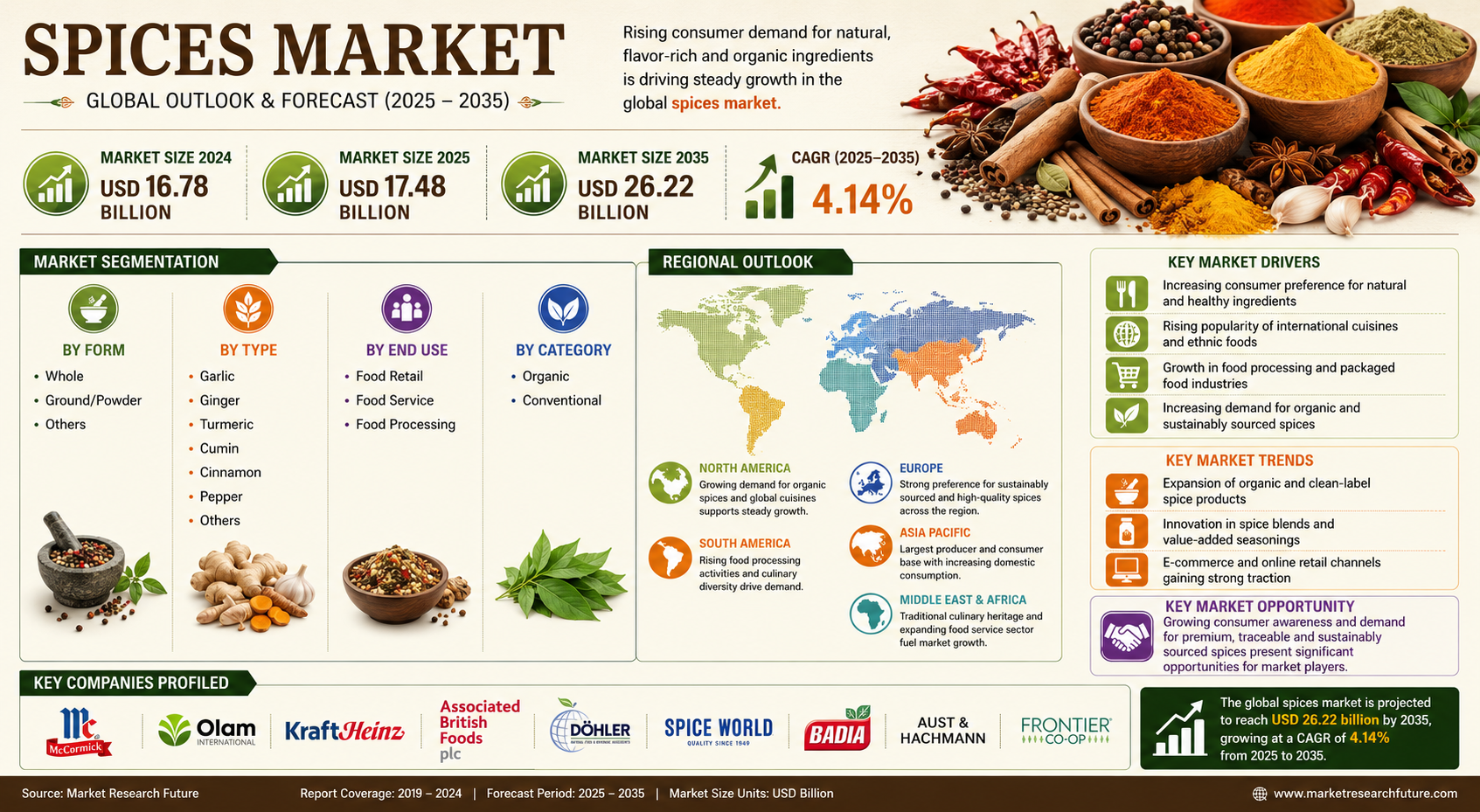
NEW YORK, NY, UNITED STATES, June 18, 2026 /EINPresswire.com/ -- The global Spices Market is experiencing steady expansion as consumers increasingly seek authentic flavors, natural ingredients, and culinary diversity in food products. According to the latest industry analysis published by Market Research Future, the global Spices Market was valued at USD 16.78 billion in 2024 and is projected to grow from USD 17.48 billion in 2025 to USD 26.22 billion by 2035, registering a compound annual growth rate (CAGR) of 4.14% during the forecast period from 2025 to 2035.— Market Research Future (MRFR)
The market continues to benefit from growing consumer interest in international cuisines, increasing awareness of natural ingredients, rising demand for organic food products, and expanding applications across food processing, food service, and retail sectors. As culinary preferences evolve and consumers prioritize ingredient transparency, spices remain an essential component of global food production and consumption.
Growing Demand for Organic Spices Creates New Growth Opportunities
One of the most significant developments within the spices industry is the increasing consumer preference for organic and sustainably sourced products. Consumers are becoming more conscious of ingredient origins, cultivation practices, and environmental impacts associated with food production.
Organic spices are gaining popularity among health-conscious consumers who seek products cultivated without synthetic pesticides, herbicides, or artificial additives. This trend has encouraged producers and suppliers to invest in certified organic farming practices and sustainable sourcing programs.
Retailers and food manufacturers are also responding to consumer demand by expanding their portfolios of organic spice products. As transparency and sustainability become increasingly important purchasing considerations, the organic spices segment is expected to remain a key growth area throughout the forecast period.
The growing emphasis on ethical sourcing and environmentally responsible agriculture is further strengthening investment in sustainable spice production systems worldwide.
Get Full PDF Sample Copy of Report: (Including Full TOC, List of Tables & Figures, Chart) @ https://www.marketresearchfuture.com/sample_request/1644
Rising Popularity of Global Cuisine Fuels Market Expansion
The globalization of food culture has significantly increased consumer exposure to international cuisines and diverse flavor profiles. As a result, demand for a broad range of spices has expanded across both developed and emerging markets.
Consumers are increasingly experimenting with home cooking, international recipes, and restaurant-inspired meals. This trend has contributed to growing consumption of spices such as turmeric, cumin, cinnamon, pepper, ginger, and garlic.
Food service providers, restaurants, meal kit companies, and food manufacturers are continuously introducing globally inspired products to meet evolving consumer tastes. These developments are creating sustained demand for high-quality spices and spice blends.
The growing popularity of ethnic cuisines and culinary exploration is expected to continue supporting market growth over the coming decade.
Food Processing Industry Remains a Major Demand Driver
The food processing sector represents one of the largest end-use segments within the Spices Market. Manufacturers utilize spices to enhance flavor, aroma, appearance, and overall product appeal across a wide variety of food categories.
Processed foods, ready-to-eat meals, snacks, sauces, seasonings, bakery products, meat products, and beverages frequently incorporate spice ingredients as key formulation components. The ability of spices to improve sensory characteristics while supporting product differentiation makes them highly valuable within modern food manufacturing.
As consumer demand for convenient and flavorful food products continues to rise, food processors are expected to increase utilization of spices and customized seasoning solutions.
Innovation within food processing applications is also encouraging the development of new spice blends designed to address changing consumer preferences and dietary trends.
Health and Wellness Trends Support Consumer Interest
Consumers are increasingly associating spices with natural ingredients and wellness-oriented lifestyles. Many spices have traditionally been incorporated into culinary and cultural practices for centuries and continue to attract attention due to their perceived nutritional and functional properties.
Ingredients such as turmeric, ginger, garlic, cinnamon, and pepper have become particularly popular among consumers seeking natural food products. While purchasing decisions are often driven by flavor and culinary applications, broader interest in ingredient quality and authenticity continues to influence market dynamics.
The growing movement toward clean-label products and minimally processed foods is further supporting demand for spices as natural flavoring agents.
Manufacturers are leveraging these trends by emphasizing ingredient transparency, sourcing quality, and product authenticity within marketing and product development strategies.
Innovation in Spice Blends and Seasonings Enhances Market Competitiveness
Product innovation remains a key competitive factor across the global Spices Market. Companies are increasingly introducing customized spice blends, regional seasoning mixes, and convenience-oriented products designed to simplify meal preparation.
Consumers are seeking products that deliver authentic flavors while reducing preparation time. This has encouraged manufacturers to develop ready-to-use spice combinations tailored to specific cuisines, recipes, and cooking applications.
Premium spice blends featuring unique ingredient combinations and specialty sourcing practices are also gaining popularity among culinary enthusiasts and professional chefs.
The ability to offer differentiated products that balance convenience, authenticity, and quality has become increasingly important in a competitive marketplace.
E-Commerce Expansion Increases Consumer Accessibility
Digital commerce continues to transform purchasing behavior across the food and ingredients sector. Online retail channels provide consumers with access to a broader variety of spices, specialty products, and international brands than traditional retail environments.
E-commerce platforms enable consumers to compare products, review ingredient information, and explore unique offerings from global suppliers. Subscription services and direct-to-consumer business models are also gaining traction within the industry.
The expansion of online distribution channels has created opportunities for both established companies and emerging brands to reach new customer segments and expand market presence.
As digital shopping habits continue to evolve, e-commerce is expected to play an increasingly important role in shaping future market growth.
Market Segmentation Analysis
By Form
Whole Spices continue to maintain strong demand due to their longer shelf life, freshness, and versatility in culinary applications. These products are widely preferred by consumers and food manufacturers seeking enhanced flavor retention and authenticity in recipes. Whole spices also offer greater flexibility for grinding and blending according to specific culinary requirements.
Ground/Powder Spices represent a significant market segment driven by convenience and ease of use in both household and commercial food preparation. The growing popularity of ready-to-cook meals and packaged food products has further increased demand for powdered spice formats. Manufacturers are also introducing premium and customized blends to cater to evolving consumer preferences.
Others include crushed, granulated, blended, and specialty spice formats developed for specific industrial and consumer applications. These products are increasingly utilized in seasoning mixes, snack foods, sauces, marinades, and functional food formulations, contributing to market expansion.
By Type
Garlic remains one of the most widely utilized spices globally due to its extensive culinary applications. Its strong flavor profile and growing use in processed foods, sauces, and seasoning blends continue to support market demand.
Ginger continues to experience strong demand across food, beverage, and specialty product categories. Increasing consumer interest in natural ingredients and traditional flavor profiles has strengthened its adoption in various applications.
Turmeric has gained significant popularity as consumers increasingly seek natural ingredients and distinctive flavors. The spice is extensively used in culinary preparations, beverages, and specialty food products across multiple regions.
Cumin remains a staple ingredient in numerous regional cuisines and processed food formulations. Its distinctive aroma and flavor make it a key component in spice blends, ready meals, and seasoning products.
Cinnamon is widely utilized in bakery products, beverages, confectionery items, and seasoning blends. Growing demand for flavored food products and premium bakery offerings continues to support segment growth.
Pepper continues to represent one of the most important spice categories globally due to its broad culinary applications. Black pepper, white pepper, and specialty pepper varieties remain essential ingredients across household and commercial food preparation.
Others include cardamom, cloves, nutmeg, paprika, coriander, and various specialty spices that contribute to market diversity. Rising consumer interest in international cuisines and unique flavor experiences is supporting demand for these products.
By End Use
Food Retail remains a significant segment as consumers increasingly prepare meals at home and experiment with diverse cuisines. The expansion of supermarkets, hypermarkets, specialty stores, and online retail channels has improved product accessibility and variety.
Food Service includes restaurants, hotels, catering companies, and commercial kitchens that rely heavily on spice ingredients for menu development. Growing demand for ethnic cuisines, premium dining experiences, and customized flavor profiles continues to drive spice consumption within this segment.
Food Processing continues to account for a substantial share of overall consumption due to widespread use in packaged and processed food products. Spices are extensively incorporated into snacks, sauces, ready meals, meat products, bakery items, and beverage formulations to enhance flavor and product differentiation.
By Category
Organic Spices are witnessing increasing demand due to growing consumer interest in sustainability and natural food products. Rising awareness regarding clean-label ingredients, environmentally responsible farming practices, and premium-quality products is supporting segment growth.
Conventional Spices continue to account for a substantial share of global consumption due to broad availability and affordability. Established supply chains, large-scale production capabilities, and widespread distribution networks continue to strengthen the position of conventional spice products in the global market.
Regional Outlook
North America
North America continues to represent an important market for spices, supported by increasing consumer interest in international cuisines, natural ingredients, and home cooking trends.
Demand for premium, organic, and specialty spice products remains particularly strong throughout the region. The United States accounts for the largest share of regional demand, driven by a well-established food processing sector, expanding ethnic food consumption, and growing preference for clean-label ingredients. Canada is also witnessing steady growth, supported by rising imports of exotic spices and increasing adoption of diverse culinary flavors.
Europe
Europe is characterized by growing demand for sustainably sourced and organic spices. Regulatory emphasis on food quality, traceability, and environmental responsibility continues to influence market dynamics.
The region's diverse culinary traditions further support demand across multiple spice categories. Countries such as Germany, the United Kingdom, France, Spain, and Italy remain key consumers, with strong demand from retail, foodservice, and packaged food industries. Increasing consumer awareness regarding product origin and ethical sourcing is further encouraging the adoption of certified spice products.
Asia-Pacific
Asia-Pacific remains a major producer and consumer of spices globally. The region benefits from extensive agricultural production, strong culinary traditions, and growing food processing industries.
Rising disposable incomes and increasing urbanization continue to support market expansion across key countries. India, China, Indonesia, Vietnam, and Thailand play significant roles in both production and consumption, while expanding exports from major producing nations continue to strengthen the region's position in the global market. Rapid growth in convenience foods and restaurant chains is also contributing to increased spice usage.
South America
South America presents growth opportunities due to expanding food manufacturing activities and increasing consumer interest in flavor-rich products.
The region's agricultural capabilities also contribute to broader industry development. Brazil and Argentina are among the leading markets, benefiting from growing food processing investments and rising demand for seasonings, spice blends, and natural flavor enhancers. Increasing urban populations and changing dietary preferences are expected to support future market growth.
Middle East and Africa
The Middle East and Africa region continues to demonstrate strong demand for spices due to deeply rooted culinary traditions and growing food service industries.
Increasing urbanization and changing consumer lifestyles are expected to support continued market growth. Countries across the Gulf Cooperation Council (GCC), along with South Africa and several North African nations, are witnessing rising consumption of spices in both household and commercial applications. Growth in tourism, hospitality, and restaurant sectors is further contributing to regional demand, while expanding trade networks continue to improve product availability across markets.
Competitive Landscape
The global Spices Market remains highly competitive, with leading companies focusing on product innovation, sustainable sourcing, quality assurance, and distribution expansion.
Key companies profiled in the market include:
• McCormick & Company (United States)
• Olam International (Singapore)
• Kraft Heinz Company (United States)
• Associated British Foods (United Kingdom)
• Döhler Group (Germany)
• Spice World (United States)
• Badia Spices (United States)
• Aust & Hachmann (Germany)
• Frontier Co-op (United States)
These companies continue to invest in supply chain optimization, sustainable procurement practices, product diversification, and advanced processing technologies to strengthen market competitiveness.
Strategic partnerships, acquisitions, and portfolio expansion initiatives remain important approaches for enhancing market presence and meeting evolving consumer expectations.
Future Outlook
The global Spices Market is expected to maintain steady growth through 2035, supported by increasing demand for natural ingredients, expanding interest in global cuisines, and rising consumer preference for organic and sustainably sourced products.
Innovation in spice blends, growth in food processing applications, and continued expansion of e-commerce channels are expected to create additional opportunities for market participants. Sustainability initiatives and transparent sourcing practices will likely become increasingly important differentiators within the competitive landscape.
As consumers continue to prioritize flavor, authenticity, quality, and ingredient transparency, the Spices Market is positioned to remain a vital component of the global food and beverage industry throughout the forecast period.
Discover Related Research Reports By Market Research Future:
Medicinal Spices Market https://www.marketresearchfuture.com/reports/medicinal-spices-market-3506
Organic Spices Herbs Market https://www.marketresearchfuture.com/reports/organic-spices-herbs-market-4175
Organic Spices Market https://www.marketresearchfuture.com/reports/organic-spices-market-1852
Sagar Kadam
Market Research Future
+1 628-258-0071
email us here
Visit us on social media:
LinkedIn
Facebook
X
Legal Disclaimer:
EIN Presswire provides this news content "as is" without warranty of any kind. We do not accept any responsibility or liability for the accuracy, content, images, videos, licenses, completeness, legality, or reliability of the information contained in this article. If you have any complaints or copyright issues related to this article, kindly contact the author above.
