

Packaging Machinery Market to Reach USD 105.2 Bn by 2036, Germany Leads as Syntegon, Krones, IMA Group Drive Automation
Packaging Machinery Market
Japan’s packaging machinery market is set to grow at a 4.0% CAGR through 2036, driven by advanced technology, precision engineering and high-quality innovation.
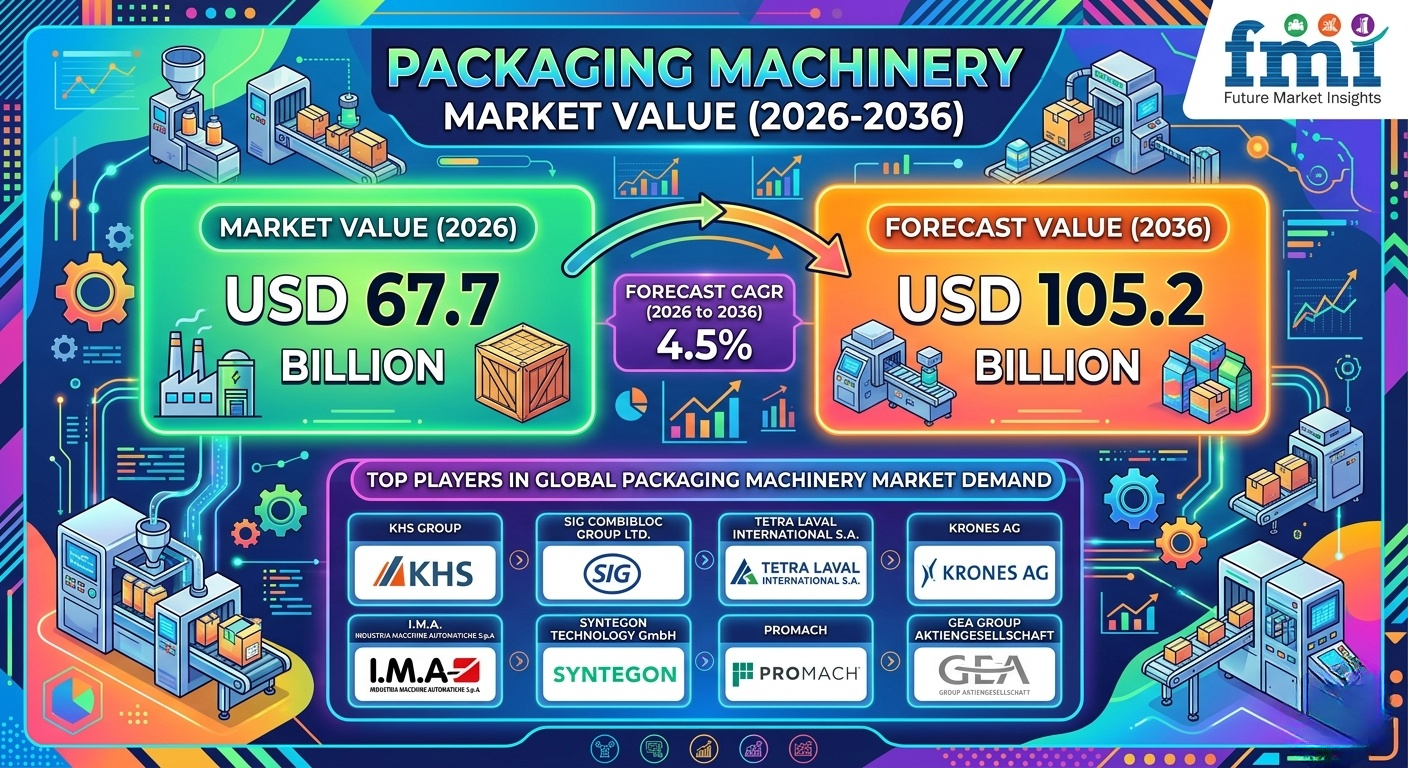
NEWARK, DE, UNITED STATES, March 26, 2026 /EINPresswire.com/ -- The global packaging machinery industry is entering a new phase of technological transformation and industrial expansion. Valued at USD 67.7 billion in 2026, the market is projected to reach USD 105.2 billion by 2036, expanding at a CAGR of 4.5% during the forecast period. This growth is primarily driven by rising automation in manufacturing, increasing packaging complexity in pharmaceuticals and food industries, and the rapid expansion of global e-commerce logistics networks.
According to a comprehensive strategic outlook from Future Market Insights (FMI), the packaging machinery market is evolving from standalone machine manufacturing toward AI-integrated packaging lines, predictive maintenance platforms, and turnkey automation solutions. The industry is increasingly defined by efficiency, flexibility, regulatory compliance, and sustainability rather than simple packaging throughput.
Discover Growth Opportunities in the Market – Get Your Sample Report Now
https://www.futuremarketinsights.com/reports/sample/rep-gb-15187
The Structural Shift: From Standalone Machines to Intelligent Packaging Lines
The packaging machinery industry is undergoing a structural transformation as manufacturers move away from selling individual machines toward delivering fully integrated packaging ecosystems. Modern packaging lines now include filling, sealing, labeling, inspection, palletizing, and digital monitoring systems operating under unified AI-driven control platforms.
One of the major drivers behind this transition is the increasing complexity of packaging requirements across industries such as pharmaceuticals, food processing, personal care, and consumer goods. Packaging machinery must now handle multiple product sizes, packaging formats, and materials on a single production line while maintaining high-speed throughput and strict quality standards.
Additionally, updated global packaging machinery safety and hygiene standards are forcing manufacturers to redesign machinery architecture to improve cleanability, contamination prevention, and operational safety. These regulatory changes are particularly impactful in pharmaceutical and food packaging, where hygienic design requirements are extremely stringent.
Industry analysts note that the packaging machinery market is entering a phase where machine intelligence, predictive maintenance, and guaranteed production efficiency metrics are becoming standard value propositions rather than optional features.
The Rise of Recurring Revenue and Service-Based OEM Business Models
Another major transformation occurring in the packaging machinery industry is the shift in OEM business models. Traditionally, packaging machinery manufacturers generated revenue through one-time machine sales. However, the industry is now moving toward recurring revenue models based on software, predictive maintenance services, performance monitoring, and service-level agreements.
AI-powered predictive maintenance systems are becoming standard features in modern packaging machinery. These systems monitor machine performance in real time, detect wear and tear, predict component failures, and recommend maintenance schedules before breakdowns occur. This significantly reduces downtime, which can be extremely costly in pharmaceutical and food production environments.
Digital twins of packaging lines are also becoming increasingly common. These virtual replicas of production lines allow manufacturers to simulate production scenarios, optimize packaging workflows, and improve operational efficiency before implementing changes in real factories.
As downtime costs in high-volume manufacturing environments can exceed the capital cost of machinery within a few years, companies are increasingly investing in smart packaging equipment that ensures consistent operational performance.
E-Commerce Expansion Driving Demand for Automated Packaging Systems
The rapid growth of global e-commerce is one of the most significant drivers of packaging machinery demand. Online retail requires packaging systems capable of handling large order volumes, multiple product sizes, protective packaging requirements, and fast shipping timelines.
Manufacturers and logistics companies are investing heavily in automated packaging systems that can process hundreds or thousands of packages per hour with minimal human intervention. Automated packaging machinery improves operational efficiency, reduces labor costs, minimizes packaging waste, and ensures product safety during transit.
The need for flexible packaging systems is also increasing as companies must package products in different sizes and formats for online retail distribution. This has accelerated the adoption of automatic packaging machinery and flexible packaging lines capable of rapid format changes.
Sustainability Driving Machinery Innovation
Environmental concerns and sustainability initiatives are significantly influencing packaging machinery development. Manufacturers are increasingly investing in machinery that supports biodegradable materials, recyclable packaging, ultra-thin packaging materials, and minimal packaging designs.
Modern packaging machinery must now be capable of handling alternative materials such as plant-based plastics, recycled paper materials, compostable packaging films, and agricultural waste-based packaging materials. This requires new machinery designs with advanced material handling capabilities, precision sealing technologies, and reduced material waste systems.
Sustainability is no longer limited to packaging materials alone. Machinery manufacturers are also focusing on energy-efficient machines, waste reduction technologies, and optimized material usage systems to help companies reduce operational costs and environmental impact simultaneously.
Segment Spotlight: Automation, Form-Fill-Seal, and Personal Care Packaging
• Form, Fill & Seal Machinery: Form, fill, and seal machinery remains one of the most important machine categories in the packaging machinery industry. These machines automate the entire packaging process by forming packaging from raw material rolls, filling products, and sealing packages in a single continuous process. This significantly increases production speed, reduces labor costs, and improves packaging consistency.
• Automatic Packaging Machinery: Automatic packaging machinery dominates the packaging technology segment due to its ability to run continuously at high speeds with minimal human intervention. These systems can process large packaging volumes while maintaining consistent quality, making them essential for large-scale manufacturing operations.
• Homecare and Personal Care End-User Segment: The homecare and personal care industry remains one of the largest users of packaging machinery. Products such as cosmetics, cleaning agents, hygiene products, and personal care items require precise packaging to prevent contamination, moisture exposure, and product degradation.
Regional Outlook: Germany Leads, India and China Accelerate Growth
From a geographical perspective, Germany holds a significant share in the global packaging machinery market due to its strong engineering sector, large number of machinery manufacturers, and leadership in pharmaceutical packaging automation.
However, the fastest growth is expected in Asia, particularly in India and China.
• India is emerging as a major growth market due to rapid expansion in food processing, pharmaceuticals, consumer goods manufacturing, and e-commerce logistics. As India continues to develop as a global manufacturing hub, companies are investing heavily in advanced packaging machinery to improve production efficiency and maintain international quality standards.
• China continues to experience strong growth due to its massive manufacturing ecosystem and ongoing investments in automation and advanced packaging technologies across multiple industries.
• The United States and the United Kingdom markets are growing steadily due to increasing demand for sustainable packaging, automated packaging systems, and high-precision packaging technologies.
• Japan remains a key market due to its leadership in precision engineering, robotics, and advanced automation systems used in packaging machinery.
Competitive Landscape: Innovation, Automation, and Strategic Partnerships
The global packaging machinery market is highly competitive and technologically driven. Major companies are focusing on automation, artificial intelligence integration, robotics, sustainability solutions, and strategic acquisitions to strengthen their market position.
Many packaging machinery companies are investing in smart packaging technologies that integrate AI, IoT sensors, machine learning algorithms, and automated inspection systems into packaging lines. These technologies allow real-time monitoring of packaging quality, machine performance, and production efficiency.
Strategic partnerships and joint ventures are also shaping the competitive landscape, particularly in pharmaceutical packaging and sterilization equipment manufacturing, where companies are consolidating expertise to provide integrated packaging and sterilization solutions.
Emerging startups are also entering the market with innovative solutions in sustainable packaging materials, eco-friendly packaging technologies, and circular economy packaging systems.
Dynamics of the Decade: AI, Robotics, Sustainability, and Hyper-Flexible Packaging
Looking toward 2036, several major trends are expected to define the future of the packaging machinery industry:
• AI-Powered Packaging Lines: Artificial intelligence will be integrated into most packaging machinery systems for predictive maintenance, performance optimization, and automated quality control.
• Robotics and Collaborative Automation: Packaging lines will increasingly use robots that work alongside human operators to improve efficiency, safety, and production speed.
• Hyper-Flexible Packaging Systems: Machinery capable of handling multiple packaging formats and product sizes on a single line will become standard as companies demand greater production flexibility.
• Sustainable Packaging Compatibility: Machinery capable of processing biodegradable, recyclable, and compostable packaging materials will become essential across industries.
• Digital Twin Production Lines: Virtual production line simulations will help companies optimize packaging operations before implementation in real factories.
Why FMI: https://www.futuremarketinsights.com/why-fmi
Explore More Research Reports by FMI
Secure Document Packaging Market - https://www.futuremarketinsights.com/reports/secure-document-packaging-market
Old Corrugated Container (OCC) Market - https://www.futuremarketinsights.com/reports/old-corrugated-containers-market
Cloth-Based Packaging for Spiritual Products Market - https://www.futuremarketinsights.com/reports/cloth-based-packaging-for-spiritual-products-market
Antibacterial Film Market - https://www.futuremarketinsights.com/reports/antibacterial-film-market
Sleeve Packaging for Extrusions Market - https://www.futuremarketinsights.com/reports/sleeve-packaging-for-extrusions-market
About Future Market Insights (FMI)
Future Market Insights, Inc. (FMI) is an ESOMAR-certified, ISO 9001:2015 market research and consulting organization, trusted by Fortune 500 clients and global enterprises. With operations in the U.S., UK, India, and Dubai, FMI provides data-backed insights and strategic intelligence across 30+ industries and 1200 markets worldwide.
Sudip Saha
Future Market Insights Inc.
+1 347-918-3531
email us here
Legal Disclaimer:
EIN Presswire provides this news content "as is" without warranty of any kind. We do not accept any responsibility or liability for the accuracy, content, images, videos, licenses, completeness, legality, or reliability of the information contained in this article. If you have any complaints or copyright issues related to this article, kindly contact the author above.
